Monday, February 28, 2011

There is a castle on a cloud.

Before we get to the wonderful city of Agra, home of the Taj Mahal, let's talk travel.  Sabrina and I agreed that no trip to India would be complete without a journey along the legendary railroads.  Typically, things in India are relatively inexpensive, but when our four hour trip cost less than three Canadian dollars each, we knew we were in for a ride.  Sure enough, the "Sleeper car" we rode in had not one, not two, but three bunks per wall, one on top of the other, and while the seats are assigned by ticket, no one really pays attention.  Sabrina and I ended up slouching on the bottom bunk (there was certainly not enough room to sit up). Several window latches were broken so the car was a bit chilly  (although I imagine in the dead of summer, the lack of air-conditioning is infinitely worse than an evening draft).  Every half hour or so, despite being close to midnight, a small man would trek down the aisle with a big urn of tea calling "Chai, chai, chai."  Since we only had to endure it for a few hours, the whole thing was quite entertaining, but we were thankful when we finally pulled into Agra.

Any residual stress from the trip instantly melted away when we stepped into the lobby of our hotel.  Like I said, things can be very inexpensive, so when we booked our reasonably priced rooms, we didn't realize that we were staying in what was without a doubt one of the most beautiful establishments in which I've ever stepped foot.  As we had an early day, and it was already nearing 2am, we headed straight for bed.

DAY 8 :
Before sunrise the next morning, our guide was waiting for us in the lobby.  Well-spoken, funny, and very knowledgeable, he led us to the car and we headed for our first sight:  the long awaited Taj Mahal.


The entrance alone is pretty impressive...


... but the structure itself is indescribable.

"The Taj" has been described as the greatest love letter of all time.  When Shah Jahan, the fifth Mughal Emperor, lost his beloved wife Mumtaz during childbirth, he swore he would honour her dying wish : build her a tomb which would preserve her memory and the memory of their love for the ages.  Now one of the most recognized structures in the world, the Taj Mahal accomplished just this, and all in the name of eternal love.

While the sheer immensity of the Taj is astounding, I believe the most breathtaking feature is in fact the smallest.  The white marble walls are covered with miniature geometric and floral designs formed by inlaid semi-precious stones, such as onyx, jasper, and malachite.  This method, known as pietra dura, can incorporate hundreds of individually carved and polished stones in a single flower or pattern.


For example, this marble table top Sabrina bought is the size of an LP and contains 600 individual stones.


Surrounding the Taj Mahal are beautiful gardens, as well as a mosque on the left, with an identical building on the right, historically used as a guest house, built to preserve the symmetry of the grounds.


One of the most surreal experiences we had was when we walked around to the back of The Taj, which faces a river.  It was still very early in the day, and the morning fog was so thick that it completely blanketed the landscape right up to the walls of The Taj.  To quote Les Miserables, this was our "castle on a cloud". 


After a quick nap back at the hotel, we headed off to the next sight, The Agra Fort : a massive red sandstone fort, not to be confused with The Red Fort in Delhi, which is similar, but not nearly as awesome.

Dating back almost 1000 years, this fort grew as subsequent Mughal emperors added buildings, courts, and palaces.  As such, there is a range of styles, from sandstone to white marble.  Originally, it even had a double moat : an outer one full of water and crocodiles, and an inner one full of shrubbery and panthers!


 While it took us a solid couple hours to see everything, less than 20% is open to tourists, as the rest of it is still used as a barracks and training ground for the Indian Army. 


 This fort hosted hundreds of years of Indian history, and saw some of the most incredible and horrifying stories, including this one :
The sixth, and final, Mughal Emperor was Aurangzeb, son of Shah Jahan (the builder of the Taj Mahal).  However, Aurangzeb was not the first in line to inherit the throne.  In fact, Dara Shikoh was Shah Jahan's favorite son. However, Aurangzed seized the throne through the murder and betrayal of his siblings.  Once he had his place in Agra Fort, he imprisoned his father within the walls.  As legend has it, on his father's birthday, Aurangzed had a servant deliver the head of Dara Shikoh, his father's favorite son, with the message "Your son sends you this to let you see that he does not forget you."

DAY 9 :
In stark contrast to the cruelty of Aurangzeb (whose reign proved very repressive, seeing the destruction of Hindu temples and the banning of music and other indulgences), the third Mughal Emperor was so accepting and caring of his people, he earned the title Akbar The Great.   It was Akbar who, in 1571, built Fatehpur Sikri, an immense and beautiful red sandstone palace dedicated to Saslim Chisti, the Sufi saint who foretold the birth of Akbar's son.

We were fortunate enough to be the first visitors of the day (the site is about 30 minutes outside of Agra).  Fatehpur Sikri is often referred to as a ghost city, because it was abandoned 14 years after construction due to a water shortage.  For this reason, I felt it was very appropriate that Sabrina and I got to wander around for an hour completely alone.
One of the ways in which Akbar earned his greatness was through his religious tolerance.  While he himself was a Muslim, he had three wives : a Muslim, a Christian, and a Hindu.  As such, Fatehpur Sikri features three separate palaces, each decorated in the religious style of its inhabitant : the floral designs of Hinduism, the geometric patterns of Islam, and the crucifix of Christianity.

It was certainly one of the highlights of the trip to be able to enjoy such a magnificent sight before it was packed with the usual tourist crowds (it also makes for better photos.)

Similarly peaceful, though not quite as barren, was Itmad-ud-Daula's Tomb, known more adorably as "the Baby Taj."  This 400 year old tomb was built by Nūr Jahān, wife of the fourth Mughal Emperor Jahangir, for her father.  It is considered a draft of the Taj Mahal, as well as a major link between the two major architectural periods of the Mughal Empire, sharing the red sandstone of the Red Fort, and the white marble of the Taj Mahal.  While paling in comparison to the Taj itself, this site is notably less crowded and overall a much more relaxing experience.
 
And with that, our adventure comes to an end.  We took a (slightly) more comfortable train back to Delhi, had one last delicious meal at hidden gem called Gunpowder, and headed to the airport.

Thanks for reading.  Now that India is sufficiently documented, I'm working on a couple of musical projects which will be making an appearance soon, so stay tuned!

24 hours in the most spiritual party city of India.

After a morning at the Qatb Minar, we headed to Indira Gandhi National Airport and hopped a plane (Spice Jet Airlines) and made the short flight to Varanasi, located on the River Ganges.  Besides producing some of the finest silk in India, and being an artistic hot bed full of poets, artists, and musicians (Ravi Shankar was born here),  Varanasi is the single holiest sight in the Hindu faith.  According to legend and scripture, Lord Shiva himself founded the city, and it was on the sacred banks of the Ganges that he ascended to heaven.  As such, every hotel, shop, and alley way features ornate idols, temples, and shrines.


The Ganges, often referred to as Mother Ganga, is regarded as a gateway to heaven, and as such, three different practices occur on a daily basis :
Firstly, the banks are the site of some 300 daily cremations. The sacred water of the Ganges is believe to have the power to wash away one's sins, and for this reason, people long to be cremated here in hopes of achieving Moksha, Hinduism's ultimate escape from the cycle of reincarnation.

However, the cleansing powers of the river are not reserved solely for the deceased.  Every morning, thousands of locals and pilgrims descend upon the banks and take a dip.  As well as the religious aspect, there are many myths various healing powers of the water.  Being that it was sunrise in late January and the Ganges is one of the most polluted rivers in the world, Sabrina and I passed in favor of staying warm on the boat. However, it's hard to imagine that there isn't something special about the Ganges, considering that locals claim no one has ever fallen ill from bathing in it.

The third and by far most spectacular occurrence on the banks of the Ganges is the sacred ritual of Aarti, when young Brahmin (priests) perform a series of songs, prayers, and fire rituals to worship the Ganges. This occurs every night, and, as the rituals are performed to Mother Ganga, the best view is obviously from a boat.  I believe we have a clip!


Many thanks to our fantastic guide Rohit (who we didn't exactly hire, but I think was part of the hotel package).  Not only did he take us around the city (which is entirely narrow backstreets and shortcuts) but he also hooked us up with a private concert with two music professors from the University.  While I would have been thrilled seeing a concert in a concert hall with a thousand other people, I was absolutely beside myself sitting in a small room with just a Sitar and a Tabla player, talking about the Indian Classical approach to improvisation and having demonstrations.  It is well known that many musicians, particularly in jazz history, have at one time or another studied this approach, which is very different to Western concepts.  If I ever have the fortune of living in India for any length of time,  I will certainly pool my Rupees and buy/rent a Sitar and study this amazing art form.

Well, the adventure is almost at an end, but we still have a few hours on a train before we get to our final destination, the city of Agra, home of the legendary Taj Mahal!

Saturday, February 19, 2011

Australia Day and the Qatb Minar

DAY 5 :
For the rest of India, it was Republic Day, celebrating the 1930 declaration of independence, but for us, it was Australia Day!  We had been invited to an apartment party to celebrate with the Australians, hosted by the same lady who had taken us around on our first day.  Now, for those of you who have ever partied with Australians, you will understand why the details of this day are hazy at best.  

Furthermore, there is only one surviving photograph of the event.  The invitation came with the insistence of Australia-inspired costumes, and this was mine.  10 points to the first person who correctly guesses. 
Hint: it's made of staff paper.


DAY 6 :
Our last chance for sightseeing in Delhi was devoted to the Qutb Complex, home of the tallest brick Minaret in the world, the Qutb Minar.

The construction of this tower began in 1193 by Qutb-ud-din Aibak, the first Muslim ruler of India.  However, to ultimately reach the final height of 72.5 meters would take the work of two subsequent rulers over the next two centuries.


This ambition but lack of foresight is mimicked in the Alai Minar, which was started in 1316 with the intention of being twice the height of the Qutb Minar.  Alas, this is how it stands 700 years later : the still impressive base of an unfulfilled vision.


Surrounding the Qutb Minar are the ruins of royal tombs, ancient colleges, and the Quwwat-ul-Islam Mosque, the first Mosque built after the Islamic conquest of India in the 12th century.


And with that, our short time in Delhi had come to an end, but our trip was far from over.  Off to the airport, and onto more adventures!  

Tuesday, February 15, 2011

Tombs, Temples, and Tourist Traps...


DAY 3:
After a couple days of hanging with friends and locals, Sabrina and I decided to get down to some serious touristing, so we grabbed our guide book and cameras, strapped on our fanny-packs and headed off to Humayun's Tomb.  (editor's note: Hi! It's Sabrina. I edit. I do not wear fanny packs.)
Humayun was the second Mughal Emperor, ruling northern India and what is now Afghanistan and Pakistan in the mid 16th century.  As well as being a great Emperor, reclaiming lost territory and expanding the empire, he must have also been a decent husband, because upon his death, it was his wife who commissioned this magnificent structure.  The Persian style architecture (presumably a result of the Persian style architect) was a first in India at the time of construction, as was the use of red sand stone, but both traits have become intrinsically linked to many of India's most historically famous edifices.  The scale and detail on these structures is breathtaking : the window (photo right) is a lattice structure carved from a single piece of marble, and the brass spike on the top of dome above is in fact 6 meters tall.


The rest of the day was spent in a couple of Delhi's most popular shopping districts : Dilli Haat, a bazaar showcasing food and handicrafts from each state of India, where Sabrina bought some beautiful pashmina scarves, and Hauz Khas Village, where we both bought kick-ass leather jackets (sheep skin, not cow hide.  Cows are sacred in Hinduism, so leather and hamburgers are off the menu).  
It was on our way to Dilli Haat where we narrowly avoided a common tourist trap, thanks to Sabrina's keen literacy.  We hopped into an auto-rickshaw and asked to go to Dilli Haat, at which point the driver passed us a business card which read "Delhi Haat" and told us that it was far away.  As well as the spelling difference, we knew that Dilli Haat was quite close.  After some arguing, we eventually cleared up the "misunderstanding" and he took us where we wanted to go. The next day, we would discover that many of these drivers receive gas coupons from the proprietors at Delhi Haat for bringing them tourists.  Furthermore, it is not uncommon for popular tourist sites to have imitators with similar names; it's the Fony televisions of tourist attractions. Nice try, guys.
That night, we headed to the Canadian High Commission (in Commonwealth countries, the Embassy is called the High Commission) and enjoyed dinner with the family of Sabrina's colleague, a welcome departure from the past three days of butter-heavy vegetable-scarce Indian cuisine.  I've never been so happy to see a salad.

DAY 4
On this fateful day, the Hindu god of tourism was full of wrath and vengeance, and he rained fire and brimstone all over our plans.  In preparation for Republic Day,  both the Red Fort (a massive sandstone fortress at the top of Old Delhi) and the Gandhi museum (a museum ... about Gandhi) were closed.  However, we did manage to gain merciful entrance to the breathtaking and aptly named Lotus Temple, a Baha'i house of worship.  

As with all things Baha'i, entry is free of charge, and we spent several meditative minutes in the very large yet very peaceful prayer room, before enjoying the lovely gardens surrounding the temple.


Upon our return home, distraught from somewhat sub-par sight seeing success, our host promised to lift our spirits by taking us to a restaurant which has laid claim to the invention of butter chicken.  While their claim may be debatable, there is no question that this is the best damn butter chicken I have ever had, and it goes without saying that we had A LOT of it.  Keeping with the theme, we went home and lay bloated on Zach's couch.

Stay tuned for Australia day celebrations, a bit more Delhi, and our travels by plane, train, and automobile to some of the other astounding sights which India has to offer.

Wednesday, February 9, 2011

Delhi, Old and New

My Indian excursion can be summed up in three words : big, spicy, and loud.  The massive crowds are matched only by the sheer immensity of the historical monuments, the food is incredible, but not for the weak of stomach (and tongue, and throat, and colon) and the aforementioned crowds create driving conditions which can only be described as a 24-hour Grade-A honk-if-you're-breathing clusterfuck.  Let's begin.

DAY 1 :
Chandni Chowk, Old Delhi's biggest market
Our first day in Delhi conveniently happened to be the same day that our host, Zach (a friend from Sabrina's high school) and his roommate/co-worker were going on a tour of Old Delhi guided by another co-worker.
This charming Australian gal (known affectionately amongst her colleagues as "The Leader of the White People") has been in India for a couple years and has managed to pick-up very functional Hindi, confidently orient herself in a city of side-streets and alleys, and (most importantly) discover the best-of-the-best of Old Delhi's streets-side snack foods (la crème de la curry, if you will).  

Sabrina on a Bicycle-rickshaw
For four straight hours we hopped on and off bicycle rick-shaws to sample everything from spicy potato dishes to paneer-stuffed pancakes to Daulat ki Chaat, a dessert which takes five hours to make and most closely resembles a cloud, if clouds were made of milk and sugar and served with nuts on top.  


(not my photo)


As a break from stuffing our faces, we also visited a stunning Jain temple (Photography prohibited. Sorry), as well as Jama Masjid, the largest mosque in India.  This mosque was completed in 1656, commisioned by the fifth Mughal emperor, Shah Jahan, the same man responsible for the legendary Taj Mahal (but we're getting ahead of ourselves).  


Now, most guide books will tell you to ease into the culinary nuances of a foreign culture.  Furthermore, they might tell you to avoid street vendors altogther.  However, Sabrina and I had a fantastically flavourful day with minimal consequences.  That said, we were rather sluggish upon our return home, so our first night was spent sharing the gifts of Israeli wine we had brought.  

DAY 2:
We awoke the next morning comfortably late, skipping breakfast as we were all still full from yesterday.  Another of Zach's coworkers, a local Delhi-ite (Delight?) who plays guitar in a rock band, had invited us all to his family's house for lunch.  Whenever I travel, I always enjoy living like the locals, so I was thrilled to be welcomed into their home to enjoy some spectacular South Indian cuisine with mother, father, and some extended family.  After lunch, we all relaxed out back in the sunshine, enjoying a truly vacating vacation for a couple hours, strolling through topics of music, politics, and high school.

When it was time to go, Zach took us to one of his favorite spots :


Pleasantly devoid of the usual tourist crowds, Deer Park is an expansive ground of ponds and paths, as well as a 15th century Madrasa, a great stone complex which served as a theological college.  After strolling through the park for a while, we were joined for dinner by another of Zach's friends at Park Beluchi, a nearby restaurant which is a definite contender for "best meal in India."  Not only were our stuffed kebabs delicious, but they were served on flaming swords!  No joke.  
That night was similar to the one before; incidentally, sitting bloated on Zach's couch would quickly become a theme of the whole trip.


That was our 48-hour easing in to life in Delhi, and now that we were settled, it was time for Sabrina and I to strike out on our own and be tourists... stay tuned.

Tuesday, January 18, 2011

Gone in 60 Seconds ...

I'm so glad I got a video of this, as it is one of the coolest things I have seen.  This is an Israeli tow-truck, and it literally just pulled up beside this car.  As with so many things, Israelis are remarkably efficient at ruining someone's day.

Saturday, January 15, 2011

Back with a vengence...

After a fantastically unproductive few weeks in Canada, during which practicing was replaced by drinking, and exercising by eating, I have returned safe and sound to the Middle East.  In an attempt to reel in the Christmas slack,  my first week back has played host to great leaps forward in my musically educational adventure across the sea.
The catalyst to all this recent success can be attributed to one man : Eddie Gomez.  This Puerto-Rican born, New York raised bassist is credited as one of the visionaries of the instrument, spending eleven years in the Bill Evans trio and playing with essentially every major jazz artist since. 
As luck might have it (and for those of you who know me well, luck often DOES have it) Eddie was flown in by the Rimon School of Music (an affiliate of Berklee College, located just north of Tel Aviv) for a week of concerts and workshops, all open to the public.  Being the public myself, I drove up to the school everyday and soaked up the vast experience and knowledge this delightfully easy-going man was offering.
Besides attending workshops by a master of the instrument, my mere presence on Rimon's campus proved to be of great benefit.  In three days, I shook hands with a bass teacher I've been trying to track down for a month, realized it wasn't geographically feasible to take regular lessons with him, and almost immediately found another teacher, based in Tel Aviv, who seemed very willing and even pleased to teach me.  Furthermore, this new teacher rather resembles one of my composition professors from university, who was a great inspiration to me during my time there.  I tend to believe, or at least take pleasure in, little coincidences such as this, and I'm very excited to start lessons.
My final achievement is one not only of musical benefit, but also of personal growth.  A young pianist of great talent had been playing during all of Eddie Gomez's clinics and such, and on the last day, I mustered up the courage to introduce myself and get his email for future jamming purposes.  Despite my outward comfort and confidence, I am prone to bouts of timidity, something I will have to get over if I plan on dropping in and out of various music scenes around the world.  Further mustering led me to ask Mr. Gomez if he would have time for a lesson, which sadly he did not.  However, I got his email as well, and if I'm ever in New York (which I very likely will be in the next few years), he said he would gladly give me a lesson then.  Come to think of it, that alone is as good a reason as any to go to New York.
All in all, my plan to drop everything and fly across the world is seeming less and less insane by the day, and my prospects for the next few months have me teeming with excitement.  I've tracked down a few open mics and jam sessions around the city, which is another big step towards actually playing with people.  The first is this Monday at Tel Aviv's Shablul Jazz Club, so wish me luck!

Music aside (though it's never that far aside), Sabrina and I are furiously reading up in preparation for our next great adventure : INDIA!  Yes, faithful blogdience, the girl and I are heading to the land of elephants, curry, and yoga for a week and a half.  Rest assured, there will be plenty of photos, and thanks to some cunning thievery of my mother's Christmas present, videos as well!

Thanks to everyone who made my trip back to Canada so wonderful, and my deepest apologies to those people I did not see due to scheduling, traffic, and inclement weather.

Cheers,
- Dony

Tuesday, December 21, 2010

O TENNENBAUM

I´ currently waiting in Franfurt Airport for my delayed flight.  We were already rerrouted to Liepzig on the way here while Frankfurt was shut down.  Now that I´m here, the only word to describe it is clusterfuck.  Everyone´s stressed, noone knows what to do or where to go, and I´m finding it to be an amazing social experiment.  Me, I listen to music while waiting in lines that go on forever and might not be the right line anyways, and this keeps me calm.  Then there are those who you can tell are stressed, but have acknowledged that the situation is out of their control, and are satisfied to occasionally shake their heads and sigh.  then there are those that feel they  are in some special scenario and deserve special treatment and have decided that speaking loudly and gesturing is the best way to get it.
There does seem to be a certain undisputed etiquette, mostly concering babies.  If you want special treatment at a hectic airport, grab a kid, stick him in a stroller, and watch the seas of people part before you and the near-murderous faces of airport staff brighten as they open a previoiusly unseen door and guide you through.  Babies is the way to go.  Me, I listen to music.

The only real casualty of my trip thus far is since I was late getting to Franfurt, I was unable to check the duty free items which I had purchased in Tel Aviv.  This meant they were confiscated and thrown out at my next security check.  The officer seeemed genuinely apologetic, knowing she was making a tense situation worse, but I´m not one to blame those who have as little control of the situation as myself.  More than the wasted money, which was by no means a fortune,  these gifts were for my Aunt and Uncle on my mother´s side, who are notoriously difficult to shop for, and I really thought I had gotten them something dandy.  Now the quesetion that plagues my mind, as I spend time blogging and not flying due to the delays, is whether or not I would have had time to check those forsaken goods, so that they might one day bring Christmas joy to picky foodies everywhere.  I guess we´ll never know.

The next plague ridden question is whether or not I have time for a beer or five before my flight. 
And with that, a very happy holidays to all, and the next time your stuck in an airport and want to throttle the next person that calls you sir, you can always cheer up by finding a smiling baby... then stay close and look like family.

Cheers,
Dony

PS (TheDonyShow accepts no liabilty for typeos or spelling mistakes, because german keyboards are wierd)

Saturday, December 11, 2010

Egypt Pt. 2

And now for the thrilling conclusion ...

As aforementioned, the next two days were not as historically thrilling as the first, but they were certainly not without there fascinating finds.  On Saturday, we took a three hour trip to Alexandria, which turned out to be a four and a half hour trip due to two factors :
First, the highway was shut down due to the same typical fog experience at Giza
and Secondly, the Egyptian police implemeneted a traffic management technique in which two patrol cars block the highway and drive one kilometer every five minutes ... I have yet to understand how this is efficicient, but my recent experience has given me faith in Egyptian logic and engineering.  Furthermore, Sabrina and I were passed out in the back of a van, so what do we care.
Finally we reach Alexandria and the first sight of the day : The Roman Amphitheatre!


Unearthed in the early sixties, the "Ampitheatre," dated to the 2nd century A.D.,  may not have been an theater at all.  It's proximity to the ancient Roman street is an unlikely location for theatrical performance, but would be ideal for the openly democratic Senate of ancient Rome.  Whatever the function,  the presenter (whether actor or politician, but really, what's the difference) was given an ingeninous advantage.  At a marked point in the middle of the circle, the acoustic resonance off the pillars is such that one's voice fills the area with an almost eerie fulness.
The rest of the sight was an ancient university (the bottom left corner of the photo).  As well as the classrooms, the excavation also revealed a written syllabus of some of the course material.

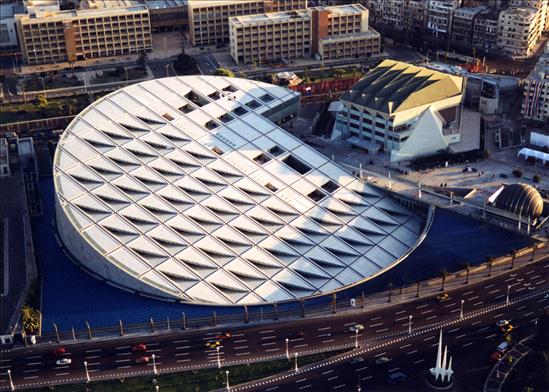
After a quick lunch at Mo'men, the Shwarma  equivalent of McDonald's, it was on to the Library of Alexandria, which is built on the location of the most significant ancient library in history, constructed some 2300 years ago.  The new building embraces a more modernist aesthetic than the first.
               Note : this is NOT my photo, as I have not yet mastered unaided flight
In accordance with ancient Egyptian sun worship, the main building represents the sun, while the dome on the right (which holds an Omni-max style cinema, and is in fact a full sphere in a large hole) represents the orbiting Earth.
Another fascinating architectural point (not properly represented in this photo) is that each window in the "sun" has a slatted awning, which mimics the human eyelash, and prevents too much direct sunlight from penetrating the reading and research area of the library.


 Inside, as well as a beautiful library, is several art exhibits, including one of modern Egyptian art, which I found to be fascinating in it's combination of traditional and modern styles.


After the library, we hopped back in the van and headed back to Cairo, napping much of the way.

Day 3 :
Our last day in Egypt was to be spent in Cairo, where there is no shortage of touristic time-killing.

First we visited Coptic Cairo.  The Coptics are a Christian sect of Egyptian origin (of which our guide is a member) and have some beautiful churches in old Egypt, the most famous of which is the hanging church.  Dating back to the thrid century A.D., the church is almost entirely suspended above an ancient fortress gateway. 

            The floor of the church


After seeing a little more of Coptic Cairo, we headed to one of the true treasures of Egypt, the Cairo Museum.  Tragically, cameras are not permitted inside the museum, so you will have to take me at my word.  The museum is massive, and as we only had a couple hours inside, we focused on two exhibits.  

The first was that of King Tutankhamun (Tut to his friends), the young prince, crowned at age 9, who was evidently murdered by his chief adviser at the age of nineteen (the same age at which he no longer legally required a chief adviser).  The museum is full of the artifacts found in his tomb (famously discovered by the British Howard Carter in 1922).  Here we learned of the Ancient Egyptian ritual of entombing the royal mummy in a lavishly decorated sarcophagus, which was then put in a slightly larger sarcophagus (equally lavish) which was then put in a larger still sarcophagus (ditto).  The three sarcophagi were then put in a big box (lavish, gold, jewels, what have you) which was placed in a bigger box (more gold, more jewels) which, finally, was put in the biggest box of all (and therefore, the MOST lavish!).  It's like a Russian doll, except the smallest doll is an embalmed corpse.

Speaking of embalmed corpses, for an additional 100 Egyptian Pounds (which is less than twenty bucks) we got to tour the mummy room!  Can you guess what's in the mummy room?  It was awesome ... and freaky ... and awesome.  Here's some more photos I didn't take :


After shaking off the willies, we left the museum and headed to our last "must-see" sight :  The Souk, Cairo's marketplace.  As I have already experienced in Tel Aviv, the marketplace is where I feel the most middle-eastern.  The streets are narrow and crowded and everyone is yelling in either a completely foreign language or something that resembles English, but not quite.  


After helping us haggle with the locals, our guide led us down several small alleyways, ultimately sitting us down at a cafe and treating us to Turkish coffee and Shisha.  The perfect ending to a wonderful trip, this is one of the few photos I got of Wassim, my favorite part of Egypt :


I hope you enjoyed my Egyptian adventure.  I'm heading back to Canada in a couple weeks, but I'm nearing completion on a couple music videos which I hope to post before I leave.
Furthermore, Sabrina and I are leaving for a ten-day excursion to India in the new year, so stay tuned.

From all of us here at TheDonyShow, I wish you good friends, good health, and good night!

Wednesday, December 8, 2010

Egypt!

Sabrina and I had planned a trip to Egypt some time ago, and we were to stay with her colleague in Cairo whilst touring around the major sites.  As fate would have it, while we were planning our trip, this same friend was planning a conference in Cairo which Sabrina was then called on to attend.  Conveniently, the conference ended the day before our planned arrival.  So, Sabrina went off on Monday, and I joined her at the hotel Wednesday, and then we moved into his place Friday.  As the conference ended Thursday, I had one day to tour around by myself, which turned out to be... well, utterly useless.  Apparently I suck at playing tourist, as I spent one hour looking for the Arabian Music Institute, and failed, and then spent another hour waiting in a restaurant for lunch, which due to a language barrier, I had apparently never ordered.  That said, I did get one fantastic photo which sums up a staple of the Egyptian diet : pita!
 I've been told that this is such a necessary food, particularly for the lower class, that is in fact subsidized by the government, and sold for a penny.  Apparently they tried to raise it to two pennies, at which point there were riots in the street.  At any extent, I would gladly pay two pennies just to watch this guy ride around all day.  Particularly given the fact that Egyptian traffic is generally terrifying.  Lanes are simply suggestions, there are very few traffic lights, and everyone always has the right of way, as long as they are honking loud enough.


After my entirely unsuccessful day, Sabrina and I had a lovely early dinner at the hotel, and then joined her colleague and her colleague's husband (who is an Egyptian native) at a traditional Arabian music concert, which I thouroughly enjoyed, and hope to investigate further.  This same colleague's husband conveniently has a friend who is a registered tour guide.  His name is Wassim, and he proved to be the highlight of the trip, as he was our personal guide for three days.  He has studied Egyptology for several years, and is incredibly well informed. Furthermore, he is the nicest, funniest man in the greater Cairo area.
Over drinks in the lobby, we planned our weekend day by day, and agreed on a meeting time, which was early by necessity.  You have to get up early if you want to go INSIDE the Great Pyramid!

Day 1 : The Pyramids of Giza!
Due to body heat and perspiration, the Egyptian authorities only let 250 people inside the pyramid each morning in the winter and 150 people in the summer, so first come, first serve. Thankfully we got tickets, and made it up the 153m ramp inside a hot stuffy tunnel, eventually popping out in a room which is utterly ... plain.  While certainly worth the experience of being inside a pyramid, it's by no means visually spectacular.  It's a stone room, with an empty stone box (in which once lay an ex-pharoah), and that's it.  However, still worth the climb.
The only catch to arriving so early is that Egypt suffers from very foggy mornings at this time of year, so it took a bit of walking around before we got a good shot, but here it is!
The Great pyramid was built for the King Khufu, and also on site are the smaller pyramids for his son and grandson.  I didn't realize this, but pyramids were actually a common tomb or monument for kings, and there are more than 100 across Egypt. 


After the pyramids, it was just a short jaunt to Egypt's second most famous site, The Sphinx!  Once again, there are many sphinxes... sphinxi?... sphinxeses? all over Egypt, but there's one REALLY BIG ONE!


On the same site as The Sphinx is the Valley Temple, where the ancient Egyptians performed the extensive rituals involved in guaranteeing the deceased passage into the afterlife.  This was an excellent opportunity to observe some ingenious Egyptian engineering :
As Egypt is prone to earthquakes (or at least was 4000 years ago), certain measures were taken to ensure that structures created solely of stacked blocks didn't topple
Separate layers have occasional shifts, to prevent sliding
in a tremor.
Corners are made of one stone, not two meeting

The next stop was Sakkara, a necropolis from the third dynasty designed by the great Egyptian engineer, Imhotep.
This site includes the supposed "Step Pyramid", which our guide ensured us is in fact NOT a pyramid, just a tomb made of steps.  If it were a pyramid, it would be the oldest ever, but it's not.


Also at Sakkara is evidence of another interesting ancient Egyptian ritual.  They believe that life on earth was only temporary and should be spent working, while the afterlife was eternal and a time of leisure.  As such, one royal burial practice was the recreation of a King's palace. While the original palace would be made of mud bricks, the recreation had to be stone, representing the temporary and eternal dichotomy.


After Sakkara we had one more stop, Memphis, which is in fact the city for which Sakkara was the necropolis aka. cemetery.
Along with a variety of ancient relics, Sakkara hosts a massive sculpture of Ramses II, who we quickly learned was quite fond of himself, as there are many statues of him built during his life.  We know they were built while he was alive, because the straight beard indicates that the subject was alive at the time of the carving, while a beard curving out indicates posthumous sculpting.


So, that was day one, which was probably the most exciting in terms of "Holy crap I never thought I would actually be here!"

I'll post the next two days in the next two days... seems appropriate.

Tuesday, November 30, 2010

Travels through the Holy Land

Greetings one and all!
My apologies for the lack of anything up here, but I've been busy playing tourist with our Canadian guests. Fortunately for me (and therefore all of you) they took lots of pictures (LOTS of pictures). So, without further ado, here is a day by day, site by site account of our adventures!

Upon arrival in Tel Aviv, the first priority was to get our guests the best falafel in Tel Aviv, which is found at Doctor Falafel! (It's not actually called that. It is called Doctor something, but it's not falafel. Doctor Delicious? Doctor Tasty?)


Our first big trip was to Nazareth, where we visited the Church of the Annunciation, where Gabriel told Mary she would give birth to the son of God.

The courtyard around the church is lined with mosaics of the Virgin Mary donated by the Catholic churches of various countries (most countries only get one, but Spain, Italy, and The Vatican each got two or three, for obvious reasons)


Before entering the church, we had to make sure we were appropriately dressed, meaning shoulders and knees must be covered.  Particularly memorable was the U.S. Marine tour group, and the officer shouting "Johnson! Go put some pants on!"

The lower part of church, called The Grotto, is fascinating because you can see how this church was built right on top of the ruins of an older church.


Further international artistic donations line the interior walls.  We all agreed that in the American interpretation of the Virgin Mary, she is made of steel and has super powers.


 Our day in Nazareth ended with meze, which is an Arab style meal where everyone shares a bunch of dips, salads, and pitas.  This included what is, without a doubt, the best hummus I have ever had.


On the way home, we stopped by the Sea of Galilee.  This was the sight of one of Jesus' miracles. Can you guess which one?


Our next big outing was to Haifa, which is the sight of the Baha'i Gardens and the temple of their founder, Bahá'u'lláh.  The gardens were funded by donations from Baha'i worldwide, and they are maintained by Baha'i volunteers.  They are free to tour, and there is nothing for sale.  The Baha'i teachings center around the eventual unity of all religions, and the equality of all people.  Besides having beautiful gardens, I feel they also have some beautiful ideas.


Our next day trip took us to Jersulaem.
The first stop was :
the Church of the Holy Sepulchre, which is on the site of the crucifixion, the burial and resurrection.

After the church, we took a tour of The Old City, which is divided into the Muslim, Armenian, Christian, and Jewish quarters, all of which can be seen from select vantage points on the roof.
A prominent Israeli writer once described Jerusalem as a city connected by its rooftops, and divided by its people.


The last major sight to see was the Wailing Wall, or the Western Wall.  This is the only remanants of the Second Temple of Judaism, and is the holiest sight in the Jewish Religion.
To understand the variety of religious significance in this part of the world, this photo shows the wailing wall in the bottom right, as well as the dome of the rock (the golden dome), which is the site of Muhammad's ascension into Heaven, and the third holiest site in Islam.


After Jerusalem, we made our way to Bethlehem for the last of our Holy hot spots.  The Church of the Nativity is built on the site of Christ's birth.
There is an elaborate shrine inside on the supposed birth spot, but there was an even more elaborate lineup to see it, and it had already been a long day. Maybe next time.


The next adventure was my favorite day by far.  It began with a late night drive to an adorable little inn close to the Dead Sea.  This was necessary as the day's activities had to start very early.
 
This is Masada, and on this day, we were all going to walk up it before the sun rose.


And we made it!

The story of Masada is an inspiring and horrific tale.  During the Roman invasion of Israel around the first century A.D. the top of Masada was the last strong hold for the Jewish people, having taken refuge in the abandoned Roman palace on top.  For months they survived on wine and preserves left by the previous tenants, all the while watching the Romans getting closer.  When they realized all hope was lost, and the capture of the palace was inevitable, they made a drastic decision.  Meeting in the makeshift synagogue, everyone wrote their name on a shard of pottery, and the ensuing lottery
decided who would kill who, ultimately leaving one survivor to tell the tale.  When the Romans crashed the gates, they found a pile of bodies.  It is said that even the Roman soldiers held great respect for the honor and bravery of those who would rather take their own life than become slaves to their enemy.  Much of the old palace still stands, as well as the giant mud hill the Romans built to siege the gates.


By the time we were done touring the top of Masada, it was getting pretty warm, so we took the cable car back down and headed off to our next destination, which I have been looking forward to since I was five years old :

THE DEAD SEA!
The dead see is the lowest point on earth, located 300m below sea level.  This location and other conditions have created the saltiest body of water on the planet.  Besides tasting awful and being unable to support much life, the salt makes the water incredibly dense, making it impossible to sink!


Another interesting property of the mineral deposits is that the mud on the bottom is rejuvenating for the skin, so another trend in the area is to slather up, let it dry, and then take a dip! While you are welcome to use the mud right off the bottom, they also sell packs of it all over Israel, which is what we used, because supposedly the fresh stuff smells awful.


While there were many other adventures, these were the major sights, and as I sift through the literally thousands of photos, I'll toss up some more fun shots, but for now, I'd like to thank the ladies for being such wonderful (and generally hilarious) guests.  You are all welcome back anytime!

As for me, I'm off to Egypt! ... seriously, stay tuned.